

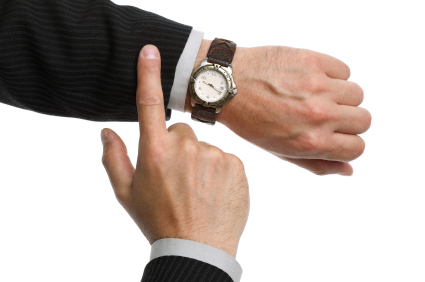
Beware of assessors who arrive before the scheduled Continuing Healthcare assessment time
 Arriving late for a meeting is something that happens to many of us from time to time. NHS Continuing Healthcare assessors are no different. If this happens, you could be concerned that there will be less time available to properly assess your relative.
However, we’re hearing increasing accounts of NHS Continuing Healthcare assessors deliberately turning up early, instead.
Why would they do this? Families are given various reasons.
We know of a case where an assessor arrived very early at a care home to do an assessment and, when asked why they were so early, they said it was to ‘do some admin’. Thankfully the family representative also turned up very early, and when the assessor realised this, the ‘admin’ didn’t actually materialise.
We know of cases where assessors have tried to start assessments before all attendees have arrived.
We know of other instances where assessors have completed the assessment forms in advance of the assessment, thereby giving the family representative and other members of the assessment team little chance to input.
Assessors who turn up early for assessments often spend a few minutes observing the person being assessed and drawing conclusions about eligibility from just those few minutes observation. Families report that these assessors often later comment that the person being assessed ‘seemed quite happy and OK’. This is of course a completely unreliable, unsafe and flawed way to carry out an assessment.
The assessor may also spend some time chatting with care staff, seeming to use this time to draw conclusions about eligibility, when in fact care staff may have no idea why they are being asked questions. Care staff may be completely unaware of the kind of information they need to provide to support an assessment for NHS Continuing Healthcare. Indeed, they are likely to (unknowingly) say words/phrases that the assessor will then use to downgrade assessment scores.
It’s hardly the transparent process that Dept. of Health guidelines specifically call for in the National Framework for NHS Continuing Healthcare and NHS-funded Nursing Care – the guidelines that all assessors have to follow.
So if you have an assessment scheduled for NHS Continuing Healthcare:
- Be sure to get there early; it’s not unusual for an assessor to arrive an hour early.
- Talk to care staff in advance about why the assessment is taking place and what kinds of needs will be assessed and how they are described in the eligibility criteria.
- Object if the assessor tries to start the meeting before everyone has arrived – including anyone who is attending on your own behalf. (Find out in advance who will be attending.)
- Check that the assessor hasn’t completed the actual assessment form before the meeting has even started.
- If you know the assessor has been chatting with care staff about your relative, ask the assessor how they made it clear to staff what the questions were all about and at what point they outlined the Continuing Healthcare eligibility criteria to those members of staff; the chances are this won’t have happened.
- Take no nonsense. If you feel that members of care staff may have been ‘got at’ – or that they maybe unaware of the importance of the assessment, because they seem to be playing down care needs and risks, make sure you raise your concerns in the assessment meeting. Check that the assessor actually writes your concerns in the notes on the assessment form. Do the same if you feel the actual assessors themselves are downplaying needs.
If you need step by step guidance through your own NHS Continuing Healthcare assessment process, you’ll find lots of help in our guide, How To Get The NHS To Pay For Care. It’s already helped many families secure NHS Continuing Healthcare funding for a relative.
Have you attended an assessment for a relative where the assessor has turned up early?


Leave a Reply to Richard Cancel reply