

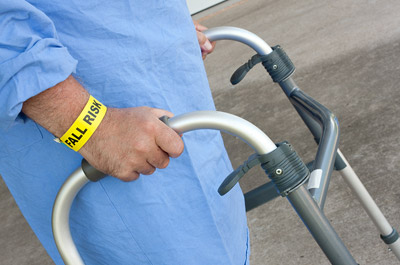

Elderly people do fall – Placing a relative into a care home is an emotionally distressing time for all parties concerned, as you relinquish day-to-day care for your relative and hand over the reins of responsibility to a third party and entrust them with your relative’s care. For many, it is the overwhelming realisation that they have tried to do their best for their relative, but the time has come when they need to be looked after by professionals in a specialist care facility.
However, in the current economic climate, where many care homes may be forced to cut corners just to remain open, there will inevitably be staff shortages and the increased risk of neglect – particularly falls.
Falls can be caused by a variety of factors including: impaired vision, hazards, medication (e.g. tranquilizers, sedatives that cause drowsiness and anti-depressants reducing mental alertness), fatigue, confusion, poor concentration, muscle weakness, poor balance, posture or gait, poor mobility, incontinence, urinary tract infections, hypotension (low blood pressure which causes dizziness and fainting), high blood pressures (taking anti-hypertensives), or other chronic conditions such as Parkinson’s, heart disease, diabetes and many more – all of which can increase the risk of falling.
Residents with advanced Dementia can have a loss of perception of depth and distance. For example, they can often misjudge how far they are from an object or be uncertain as to the difference between a flat or raised surface. They may try and avoid a shadow or a dark area on the floor or carpet by going around it, as they perceive it to be a hole in the floor and fear falling into it. This inability to distinguish depth and distance can certainly increase the risk of falling.
It has been said that one out of every three people 65 years and older fall each year, and once they’ve fallen, they’re two to three times more likely to fall again within a short space of time.
The question is whether the fall was merely an isolated incident or accident, just part of the ageing process or an indication of a change in their cognitive functioning or general well-being? You need to know what caused their fall. Multiple falls in a short space of time are a matter of even greater concern.
At best, elderly and frail residents in a care home facility might get away with suffering minor soft tissue injuries, bumps and bruises – which is bad enough. In more serious falls, fractures, dislocations and head injuries are common. In vulnerable patients, such injuries can lead to physical long-term disability, restriction of movement, impairment, loss of independence, distress, and a loss of confidence through fear of falling again. Psychologically, they can become introverted, reclusive and depressed. Even if they weren’t injured, the fear of falling itself can lead to a reduction of everyday activities and inactivity, gradually becoming weaker and increasing their risk of falling.
Sadly, falls can often become a turning point and the catalyst for the onset of other life-changing medical conditions and complications, and the start of a downward spiral of deteriorating health. Some falls can be catastrophic. How often do we hear heart-breaking accounts from children telling us how mobile and independent their parents were before they fell, and how rapidly they declined afterwards.
The older the individual, the longer it generally takes to recover from a nasty fall. In some instances, residents may be too frail or elderly to run the risk of surgery and general anaesthetic and are left to suffer in pain. What starts with a fractured hip or pelvis can lead to reduced mobility, becoming bed-bound, incontinence, UTI’s and pressure sores.
There is a clearly a need to improve the care for the elderly and especially those who are at high risk of falling. Elderly people and those with balance issues such as Parkinson’s, do and will fall. The risks of falling increases with age and frailty. However, the greater the risk, the greater the need to protect them and implement precautions, frequent assessment and monitoring.
When your relative enters into a care home, staff should carry out a full risk assessment which will include a Falls Risk Assessment – a tool to assess their likelihood, risk and consequences of falling. This will enable the care home to create a strategic risk prevention Care Plan to minimise (or hopefully, eradicate!) the risk of them falling and causing injury.
Accidents can happen, but here are a few things to ask yourself when next visiting your relative in their care home:
- Has your relative fallen before, how often and are they known to be at risk of falling?
- Do they have mental capacity to appreciate risk and dangers?
- Do they hallucinate or exhibit inappropriate behaviour or aggression that could increase their chance of falling?
- Is their medication likely to make them prone to falling or increase the risk of falling?
- Does their medication need reviewing, changing or even discontinuing?
- Are they eating properly? Look out for weight loss as this can cause reduced muscle strength.
- Is their diet right? Low energy levels and low blood sugar can cause fainting and dizziness, especially in diabetics.
- Do they need to mobilise or exercise more?
- Is their footwear appropriate or even missing?
- Is their balance off kilter?
- Are they prone to wandering (unobserved)?
- Does their room need any hand/grab rails?
- Does their bedroom need better lighting?
- Do they need a walking aid for support and confidence?
- Has their vision altered, and does it need reassessing?
- Are they unsteady on their feet and need to be observed more often?
- Is their Falls Risk Assessment and/or Care Plan accurate or does it need updating? When was it last reviewed?
- Do they need closer supervision and assessing for 1: 1 care?
- Do they fear falling?
- Is there a pattern as to when they fall e.g. at night-time when there are reduced staff on duty?
Watch out! Unsupervised falls could be an indication of a lack of staffing and neglect.
We often hear from our readers that their parent or spouse fell several times in a very short space of time, and naturally that leads them to question the adequacy of care and supervision in place.
If this happens to your relative, ask to speak to the care home manager and get an explanation as to when and how the fall occurred. Could the care home have done more? Is there neglect?
Ask to see their Care Plans and Falls Risk Policy. Check whether they are being adhered to or need updating and whether they accurately reflect the nature and characteristics of the risks to your relative?
Don’t rely on the care home to keep accurate records. They are often too busy to make good notes. Keep a log of all falls, actual or near misses, as evidence of the standard of care provided and potential neglect.
Enquire as to what precautions are going to be instigated to prevent similar occurrences in the future.
Get confirmation of your discussion and the care home’s assurances in writing.
Hold the care home to account and ensure that they implement and monitor the agreed plan of action and consult you when any changes are made.
Handle the matter with sensitivity, but above all, don’t be fobbed off or afraid of rocking the boat! This is your relative’s health at stake. If you have concerns, then you must speak up! Don’t leave it until it’s too late and they’ve had another fall or been admitted to hospital.
What is not acceptable is for the care home to say in their defence is:
- ‘Well elderly people do fall, don’t they!’
- People with Dementia will fall’
- ‘We’re doing our best but we can’t prevent every resident from falling’’
- ‘We cannot watch your mother 24 hours a day’
- ‘Your father falls at night when we have fewer staff on duty’
You have entrusted your relative into their care and the care home has a duty to ensure their safety and well-being at all times.
If you are really unhappy with the situation, you can always report the matter to the Care Quality Commission (CQC) who may decide to carry out an investigation and conduct a safe-guarding report.
Quite often, family members aren’t told about their relative’s fall at the time (or at all!) unless they happen to find out by chance. So, much can go unnoticed and even covered up – not wanting to alert or distress the family – particularly in the current COVID climate where close family have been excluded from visiting relatives in care homes.
Incidents of falling may not appear in the care records for a variety of reasons – not least perhaps because of simple unintentional omission, or the fall was unwitnessed and no one picked it up, or the resident was unable to communicate their pain from the injuries sustained, or out of staff embarrassment that a resident in their care has fallen on their watch.
However, care homes can take some simple but effective measures to reduce the risk of their residents from falling. Such as, fitting sensors or an alarm if the patient leaves their room unassisted, and putting crash mats by the bed (with sensors) to alert staff in the event of a fall.
There are various falls risk assessment tools, but whichever one the care home uses, it should be compliant with the NICE guidelines: Here’s a helpful link:
https://www.nice.org.uk/guidance/cg161/chapter/recommendations#extended-care
Summary
We looked at this issue of the elderly falling over a year ago in our blog:
Focus: Falling at the care home
But, with an ageing population, the problem isn’t going to go away soon and judging by the enquiries and comments we receive, it is only getting worse.
Falling at a care home could be an indication of your relative’s deteriorating health and be part of the ageing process or advancement of an existing condition – but that just increases the need to be vigilant and monitor their surroundings and physical and psychological well-being more closely. Investigate the cause of the fall. But, regardless, ensure that the care home puts in place adequate safety measures immediately to avoid a similar repeat occurrence happening or worse.
If you believe there has been clear neglect, we recommend that you seek specialist legal advice.


Leave a Reply to Michelle wetherall Cancel reply